Child Pools and the LaunchHook
The buzz
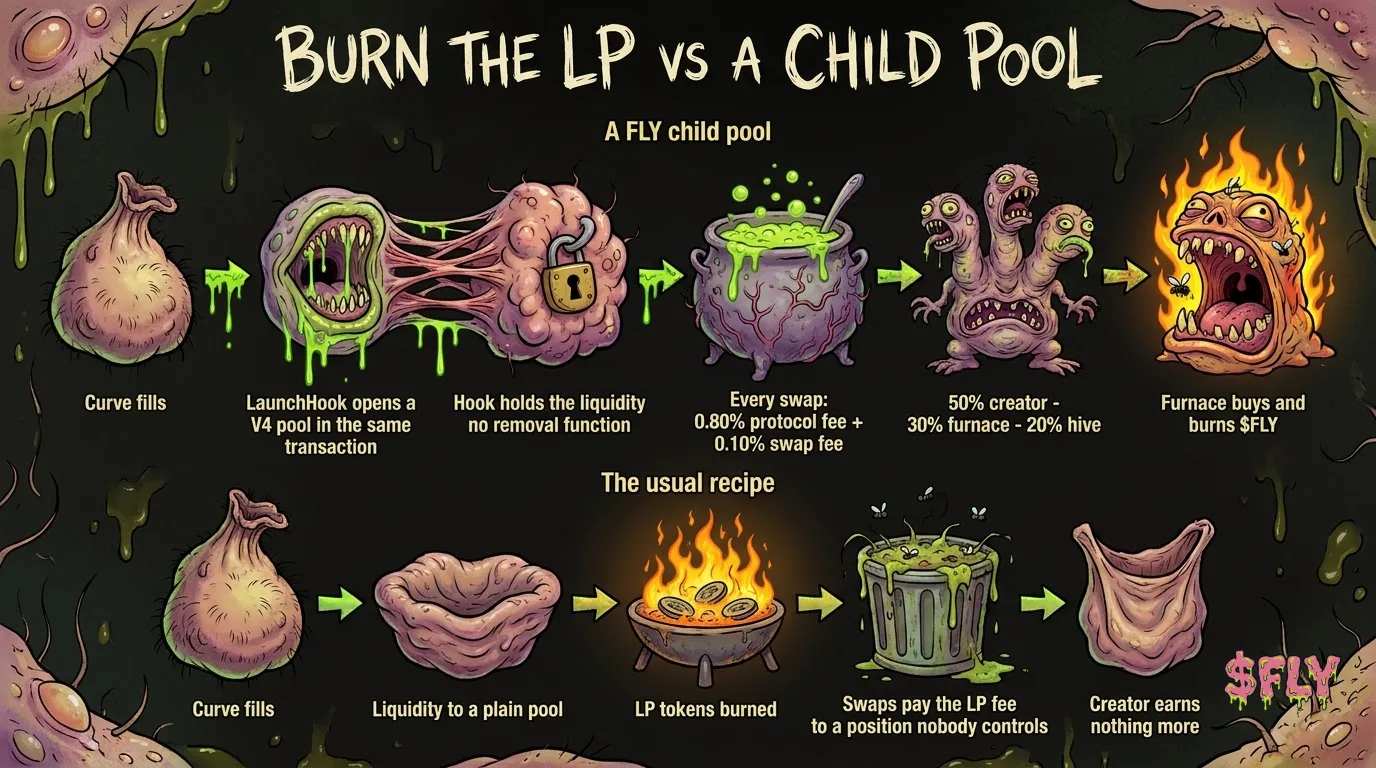
The usual launchpad recipe ends the story at graduation: dump the curve's money into a pool, burn the LP tokens, confetti. 🎉 The token is "free". Also: nobody is paid to care about it ever again, and whatever the pool earns from then on goes nowhere useful.
The FLY Launchpad graduates every token into a child pool — a Uniswap V4 pool plugged into
the hive's own hook, LaunchHook. Same idea as $FLY's Living Pool: the pool has a brain. It
charges a fee that the creator, the furnace and the hive split on every single swap, and the
liquidity it was born with is welded shut. 🐝
The boring part
What a V4 hook is
Uniswap V4 lets a pool name a contract — a hook — that the pool calls before and after swaps. The
hook can set the LP fee for each swap and take a cut in the same transaction. LaunchHook is
one hook serving every graduated launch at once; each launch's pool is registered with it
by the factory, and it refuses to let anyone else open a pool under its name.
What LaunchHook does
| When | What |
|---|---|
| At graduation | takes the 1.2% graduation fee from the raise (half to the FLY owner, half to FlyFurnace), opens the V4 pool at the curve's final price, adds a full-range position with the other 98.8% that the hook itself holds, burns the leftover tokens |
| Before every swap | sets the LP fee: 3.00% the moment the pool opens, falling in a straight line to 0.35% over 30 minutes, then 0.35% for good |
| On every swap | takes the 0.80% protocol fee in the pairing asset and credits it: 50% to the token's creator, 30% to FlyFurnace, 20% to the FLY owner — plus the 0.10% swap fee, half to the FLY owner and half to FlyFurnace. Credits are paid out by a claim (anyone can trigger it; the money goes to the recipient), so a trade never depends on a recipient being able to receive |
| Every 15 minutes, by itself | the first swap collects what the hook's locked liquidity earned: the child-token half is burned, the pairing-asset half is locked as a floor under the price (placed against a time-weighted price, never withdrawn) |
| Never | removes liquidity. There is no function for it. The position goes in once and stays |
The opening 3% LP fee makes the first minutes after graduation expensive to farm and pays the pool's liquidity for taking that flow; it settles to 0.35% by itself half an hour later. The protocol fee of a pool is fixed when the pool is registered, so it never moves under a live pool (the owner can change it for new launches, up to a hard cap of 1%).
Burn-the-LP vs a child pool
Why it matters for $FLY
Every child pool is a small, permanent $FLY buyer. The furnace's share arrives in each pool's pairing asset — USDG, WETH, FLY or a stock — and each time the burn runs (a keeper presses it on a schedule, the FLY owner is the backup), the furnace turns it into USDG, buys $FLY through the Living Pool with it, and burns what it bought (FLY that arrives as FLY is burned as it is). More launches, more graduations, more volume in the child pools: more $FLY bought and burned. That's the whole flywheel. 🪰🔥
And the LPs?
The hook's own position is the pool's floor of liquidity, and anyone can add more alongside it from Pools → Provide Liquidity on the launchpad. Providers earn the LP fee on their share, including the 3% opening window.