Launchpad Fees and Pairings
The buzz
Six fees, three wallets, one furnace. Every cent has a destination and every destination is a line in a contract. And you can pair a launch with a dollar, with ETH, with $FLY — or with NVIDIA. Your memecoin, bonded to a Mag-7 stock. Few understand. 📈🧠
The boring part
Every fee and where it goes
| Fee | Rate | Creator | FlyFurnace (burns $FLY) |
FLY owner | Liquidity providers |
|---|---|---|---|---|---|
| Launch fee | flat 0.0006 ETH | — | 50% | 50% | — |
| Curve fee (before graduation) | 1.1% of every buy and sell | — | 50% | 50% | — |
| Graduation fee | 1.2% of the raise, once, as the launch graduates | — | 50% | 50% | — |
| Protocol fee (child pool) | 0.80% of every swap | 50% | 30% | 20% | — |
| LP fee (child pool) | 3.00% → 0.35% over the first 30 minutes, then 0.35% | — | — | — | 100% |
| Swap fee (child pool) | 0.10% of every swap | — | 50% | 50% | — |
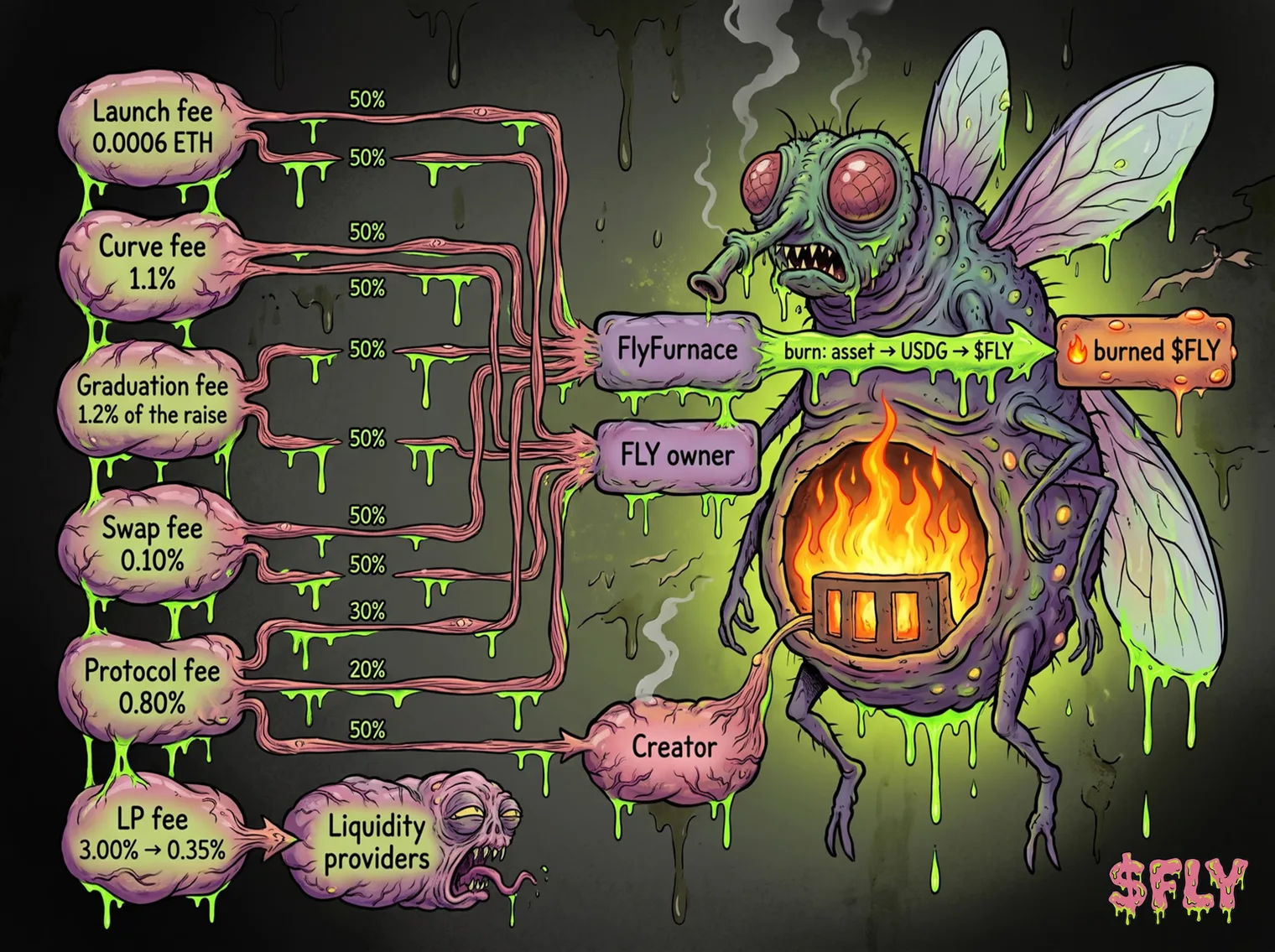
The graduation fee comes out of what the curve raised, before the child pool is seeded: the pool gets the other 98.8%, still opening at the curve's own final price — it simply holds a little less liquidity, and a little more of the unsold supply is burned.
The swap fee lives in the contracts, so no route can skip it: in the curve's 1.1% (the 1%
curve fee plus 0.10%, the same 50/50 split) and in LaunchHook on every child-pool swap, next
to the protocol fee, in the pairing asset. On FLY's own market it is part of FlyHook's 0.90%.
The child's own burn and floor — automatic
The hook's locked liquidity earns LP fees like any other position. Every 15 minutes of trading, the first swap collects them before it trades, with nobody pressing anything:
- the child-token half is burned — the child's supply only goes down;
- the pairing-asset half is locked as a floor: a bid just under the child's price that fills as the price falls and can never be withdrawn — FLY's own floor, built for every child.
The floor is placed against a time-weighted price, so pumping the price just before a harvest does not drag the floor up under the pump.
Fees are credited inside the trade and paid out by a claim. A swap records each recipient's
share (the creator, the furnace, the FLY owner) as a balance in the hook and moves on; anyone can
pay a balance out with claimFees(recipient, token), and the money always goes to the
recipient, whoever presses the button. Nothing is pushed to a wallet during a trade, so a
recipient that cannot receive — a frozen address, say — can never block anyone's swap. A creator
sees the balance, and a claim button, on the Portfolio page. Before graduation the curve's fees
work the same way: they accrue in the pool and anyone can send them on with flushFees().
A pool's protocol-fee rate is fixed when the pool is registered; the owner can set it for future launches, never above 1%. The LP fee schedule is one setting for all child pools (start at most 5%, decay window at most one day).
The furnace
FlyFurnace collects the hive's share in whatever asset it arrives in and turns it into burned
$FLY: it swaps the asset into USDG through the asset's reference pool, buys $FLY through the
Living Pool, and burns every $FLY it bought. The furnace keeps nothing; it has no other
exit. There are two ways to run it:
- By the keeper, automatically —
autoBurn(asset). A hot key the FLY owner names calls it on a schedule. The caller states no minimum; the contract works one out. The USDG-to-FLY swap must return at least what the FLY hook's own reference price buys (the cheaper-FLY of today's price and the 4-hour average), less a tolerance (5% unless the owner sets it, between 1% and 10%). So a pump in front of the burn makes the call revert instead of burning less, and a stolen keeper key can lose at most the tolerance on one burn. One call swaps at most a cap (25 USDG unless the owner sets it), because the tolerance has to cover the burn's own price impact; a bigger pot is burned over several calls. After a real rally the burn waits, quietly, until the average catches up. - By the FLY owner, by hand —
burn(asset, minFlyOut). The owner states their own minimum. This is the backup if the keeper ever stops, and nobody else can call it.
The honest limit: the guard covers the USDG-to-FLY swap. An asset that is neither USDG nor FLY (ETH from launch fees, WETH, a stock token) is first swapped to USDG through its own pairing pool, and that first hop has no time-weighted price to check against, so a sandwich of that hop could take part of that asset's balance. Those balances are small, and the owner can burn them by hand.
What a launch can pair with
A launch is bonded to one pairing asset for life. Its $3,000 target is converted into that asset when it launches, through the asset's own pool against USDG.
| Pairing | What it is |
|---|---|
| USDG | Paxos' Global Dollar — the numeraire, always $1 to the launchpad |
| ETH | wrapped ETH (WETH) on the curve; you can still pay in native ETH — the router swaps it through the ETH/USDG pool |
| $FLY | the hive's own token — a buy paid in USDG or ETH hops through the Living Pool to get there |
| SPY | S&P 500 ETF (Robinhood Stock Token) |
| NVDA | NVIDIA (Robinhood Stock Token) |
| META | Meta Platforms (Robinhood Stock Token) |
| AAPL | Apple (Robinhood Stock Token) |
| MSFT | Microsoft (Robinhood Stock Token) |
| AMZN | Amazon (Robinhood Stock Token) |
| GLD | SPDR Gold Trust (Robinhood Stock Token) |
The seven stocks are Robinhood's own Stock Tokens on Robinhood Chain, each priced through its Uniswap V4 pool against USDG. On testnet they are stand-ins with the same tickers ("Test NVDA" and friends), so every flow can be rehearsed before mainnet.
Paying with anything
You don't need to hold a launch's pairing asset to buy it. The LaunchRouter takes USDG, ETH,
$FLY or the pairing asset itself and hops through the pools in one transaction — up to three
hops:
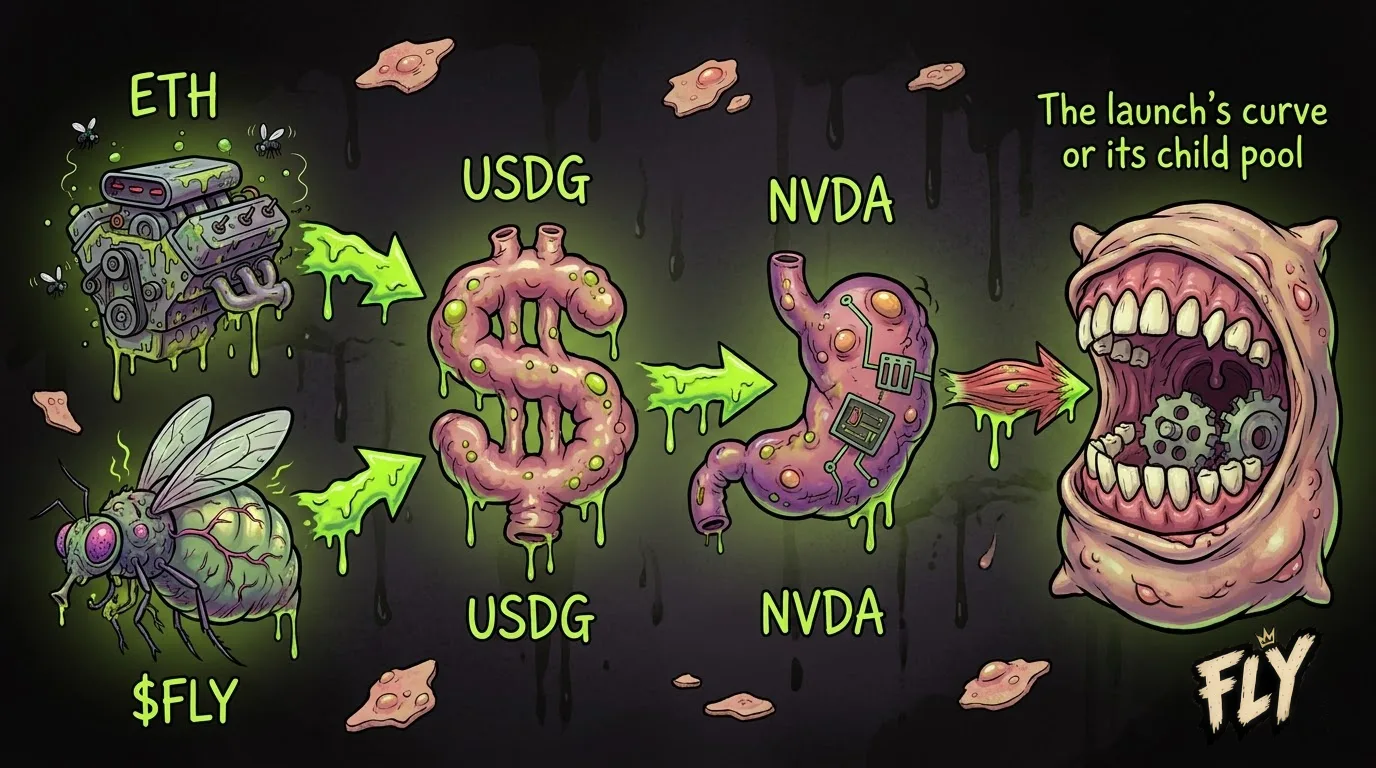
So buying an NVDA-paired launch with ETH is ETH → USDG → NVDA → the curve; selling it back into ETH runs the other way. Every candidate route is quoted and the best one wins, with a thumb on the scale for the hive: a route through FLY-ecosystem pools is picked if it is within 0.5% of the best. 🍯
Both televisions use it — the launchpad's trade page and the hive's own on fly.christmas — so a launch can be bought or sold from either, with any of the assets above. (The hive's television keeps $FLY against USDG or ETH on the hive's own pool; see Buying and Selling.)