A Launch, Start to Finish
The buzz
Name, ticker, logo, pick what it pairs with, press LAUNCH. That's the creator's whole job. The rest is a machine: a curve that prices every buy, a finish line at $3,000, and a graduation that happens inside the buy that crosses it — no "migration in progress", no bot racing you to an empty pool, no dev holding the button. 🫡
The boring part
The lifecycle
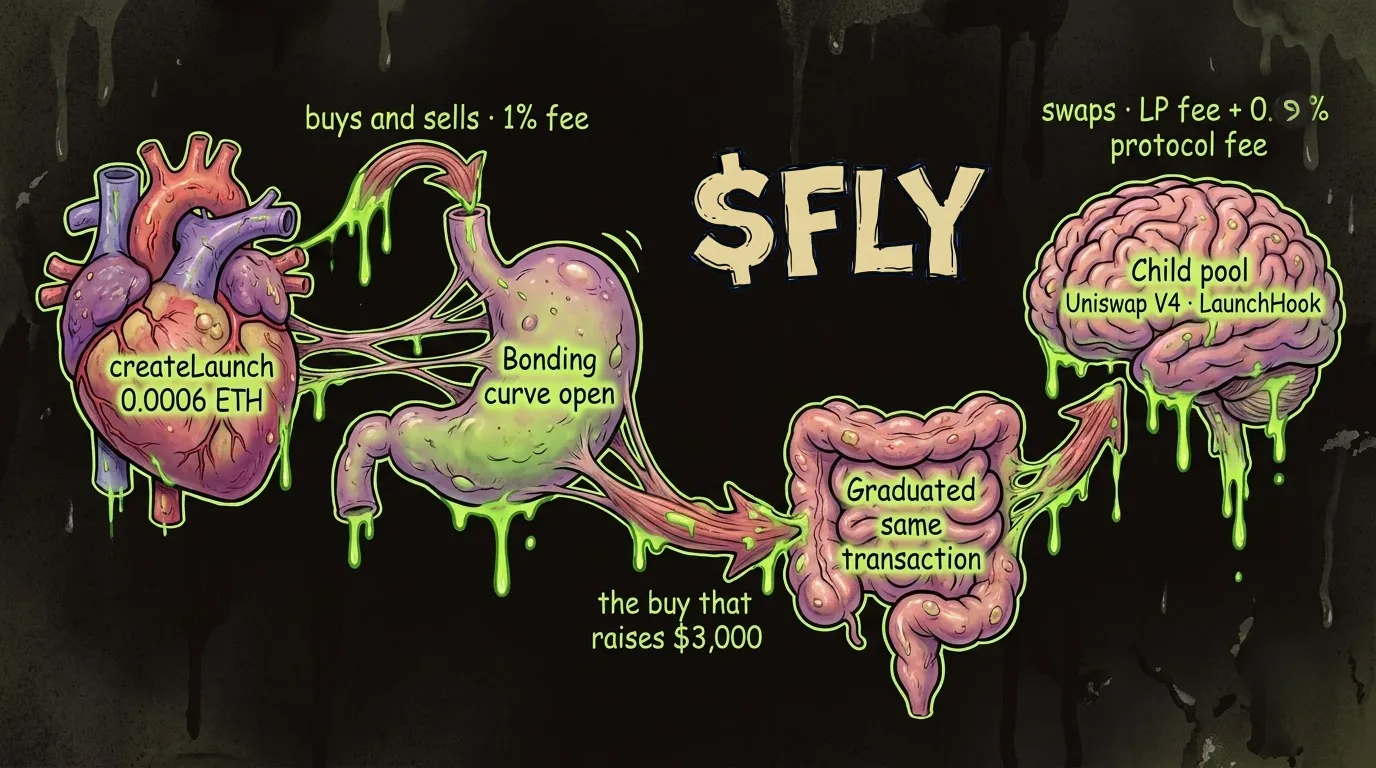
- Launch. The creator calls
createLaunchwith 0.0006 ETH. The factory deploys the token (100,000,000 supply, fixed — no mint function after this) and itsBondingPool, and hands the pool the entire supply. The contract also takes an optional premine buy in the same transaction: the creator's own first buy, executed before anyone else can see the token exists. Sniper-proof by construction. (The launch page doesn't offer it yet.) - The curve. Anyone buys and sells against the
BondingPool. The price follows a constant-product curve with a virtual reserve of 20% of the target, so it opens low and rises with every buy. Every trade pays 1.1%. - Graduation. The target is $3,000 of the pairing asset, fixed in that asset's units
when the token launches (priced through its pool against USDG). If the pairing asset's price
moves afterwards, the target's dollar value moves with it:
Launching Well. The buy that reaches it
graduates the token in the same transaction:
LaunchHooktakes the 1.2% graduation fee from the raise, opens a Uniswap V4 pool at the curve's final price, seeds it with the other 98.8% and the tokens that go with them, holds the position itself, and burns the tokens left over. Trading on V4 opens in that same block. - Child pool life. From then on the token trades in its V4 pool under the hive's hook. Every swap pays the LP fee, the 0.80% protocol fee and the 0.10% swap fee, and every 15 minutes the hook's locked liquidity burns child tokens and builds the child's floor — see Launchpad Fees and Pairings.
If a filling buy arrives without enough gas left for the graduation (the contract reserves
700,000; the measured need on testnet was about 520,000), the buy
still goes through and the pool waits in GraduationPending; anyone can then press
GRADUATE on the token page, which calls graduatePool and does the same thing.
The graduating buy, step by step
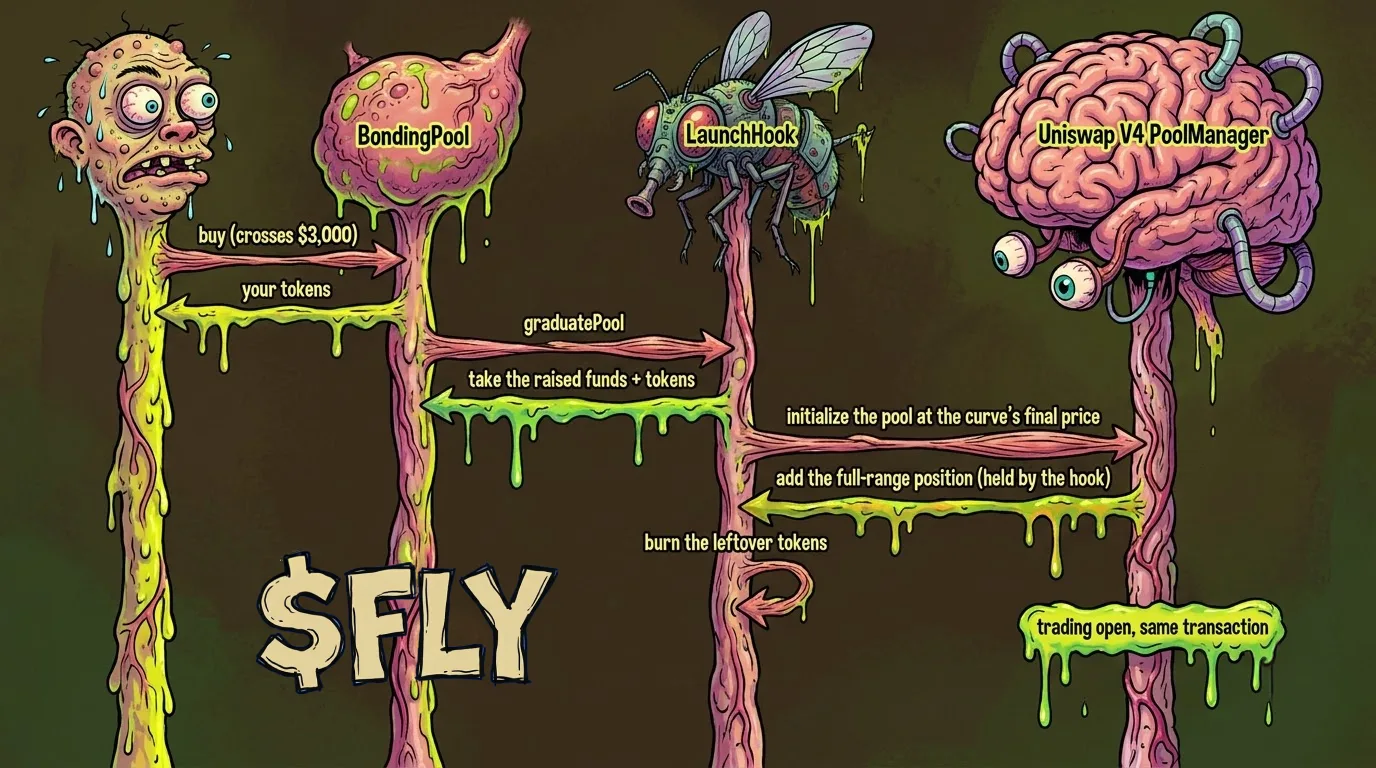
Between taking the raise and opening the pool, LaunchHook takes the 1.2% graduation fee
from it, split between the FLY owner and the FlyFurnace.
The shape of every launch at $3,000
| Virtual quote | Target | Opening price | Sold on the curve | Final curve price | Rise | Into the V4 pool | Burned | FDV at graduation |
|---|---|---|---|---|---|---|---|---|
| 600 | 3,000 | 7.500e-6 | 66.7M | 2.700e-4 | 36.0x | 11.0M | 22.4M (22.4%) | 20,964 |
Prices and FDV are in units of the pairing asset (for a USDG launch, dollars). The minimum gross buying to graduate is 3,033.37, of which 33.37 is the 1.1% curve fee. At graduation 36 of the 3,000 raised is the 1.2% graduation fee; the pool is seeded with the other 2,964 and the ~11.0M tokens that match them at the curve's final price.
What the creator earns
Nothing on the curve — the curve fee goes to the hive — and 50% of the protocol fee on every swap, forever, once the token graduates. The creator's only pre-graduation play is the premine buy. So the one way for a creator to get paid is to make the thing actually graduate. Aligned incentives, ser. 🧠